

By Krisztina Sved
This essay began during three weeks I spent in Japan last summer, including several days in Tokyo. Somewhere between the streets, the silences, and the rhythm of the city, an atmosphere began to stay with me. It was deepened by an observation shared by Prof. Akira Ikemi, that Focusing can be recognised in Murakami’s novels, and by Prof. Hideo Tanaka’s reflections on explication and bodily recognition. If Focusing can be recognised in literature, I wondered whether something similar might also be present in other forms of art, including film.
Wim Wenders’s Perfect Days (2023) evokes an exceptional calm that invites slowing down and attention. It follows a middle-aged man, Hirayama, who cleans Tokyo’s public restrooms. His life seems ordinary, almost minimalist - built from modest rituals, repeating movements, and small, caring gestures. Yet beneath the routine surface a quiet, deep meaning unfolds: an atmosphere that invites the viewer not to interpret, but to feel.
Wenders’s camera moves like a Focusing companion: it attends, it pauses, and it lets life show itself. The world of the film leads into a space where understanding is born from bodily felt experience. This connects closely to Eugene Gendlin’s thinking, especially the implicit and focusing attention - according to which experiencing is always more than words can express (Gendlin, 2009). Tokyo breathes in the space of ma[1] (the in-between silence); in the meeting of light, rhythm, and caring gestures, the implicit gathers, takes form, then steps forward. And we notice how meaning moves within us.
When the Body Wakes Before the Mind
Hirayama’s life is composed of movements that evoke the quality of the felt sense. Every morning he rises at dawn, folds the bedding, waters his plants, and carefully chooses a cassette for the day’s ride. These are not mere habits but bodily orientation acts - little doors into presence. Wenders’s patient camera lets these movements breathe; time slows, and the body’s knowing becomes visible. The viewer’s body also responds: it senses the quiet fullness that lies in simplicity.
According to Gendlin, the felt sense is “the bodily felt meaning of a particular problem or situation” (Gendlin, 2009, p. 31). It is not merely emotion or thought, but “an implicit wholeness that has not yet been formulated, but already carries the next step” (Gendlin, 2004, p. 133). Wenders’s film lives in this process: the body’s knowing moves gently before consciousness.
Life’s Implicit Weave
In the world of Perfect Days, everything essential remains unspoken. We never learn why Hirayama lives alone, what he hopes for, or what happened earlier in his life. And yet every silence, every pause contains something dense and alive. The past is present not as narration but as vibration: in the way he looks up at a tree, in how he watches his niece at the moment of departure, or how he listens to the night sounds at the open window. The city - the noise of traffic, the play of light and shadow - is not background but a living space that breathes with Hirayama’s movements. Wenders’s camera does not explain; it attends. Something of this silence moves in the viewer’s body as well.
This is the experience Gendlin describes when he speaks of the implicit: a living process that precedes conscious interpretation yet is always already at work (Gendlin, 2009). It is not a hidden depth but life’s own self-organization, from which meaning unfolds before it becomes words. Gendlin calls the same thing the movement of carrying forward - the natural forward-leading direction in which life continues to shape itself (Gendlin, 2004, p. 128). In the film this movement is not visible, yet palpable: meaning is born not as explanation, but as bodily resonance in the viewer.
The Body’s Quiet “Yes”
The most moving moments of Perfect Days are not plot turns but the silences of recognition. When Hirayama’s young coworker starts taking photographs, the older man smiles - a quiet, indulgent smile in which understanding and kindness are present. When his niece leaves, the silence between them carries both distance and tenderness; for a moment the pain shows itself without being spoken. And in the closing scene, when Lou Reed’s “Perfect Day” plays and a tear appears on Hirayama’s face, feelings that had only been hinted at now take on a body: gratitude, passing, fullness.
Gendlin calls this moment bodily recognition - when implicit content finds a form and the body says inwardly: “Yes, this is it.” This is not an intellectual insight, but the bodily sense of rightness (Gendlin, 2009). In such moments the body’s knowing and consciousness meet, and for a brief instant everything that had been unspoken comes into alignment. The film shows precisely this moment, when outward motion slows, but inside a whole world moves.
Silence Taking Shape
In Perfect Days, expression is never primarily linguistic. Hirayama does not speak about his feelings, yet every movement is expressive. When he arranges wiping cloths, waters plants carefully, or returns the tape to its case, these are acts of feeling taking form. The body expresses what the mind would not yet say - this is the film’s forming.
Gendlin names this process explication: when the felt sense finds a form in something we can say, write, or - as here - live. It is not analysis but unfolding: embodied meaning stepping forward as the implicit becomes form. Wenders renders this in a visual language: silence, rhythm, light, and music are the tools of explication. Meaning is born not in assertion but in movement. And in the viewer’s body, likewise, something continues: the process of forming goes on within us.
Four Movements, One Rhythm
The movements of Perfect Days repeat slowly, in circles: Hirayama gets up, makes the bed, waters plants, shaves, pockets his keys and coins for the vending machine, buys coffee, sets out, selects a cassette, then begins work. In the evening he reads, and the next day everything begins again.
But not only the days; the weeks have their own cycle too: the laundromat, shopping, dinner at the diner, a drink at the bar. Yet this repeating rhythm is not monotonous, because in every day there hides a fine shift - a quiet carrying forward.
This rhythm is not only the structure of the film; it is also a movement of understanding: the viewer senses, gives form, recognizes, then senses again. In this movement Wenders’s film, Gendlin’s experiential process, and Dilthey’s hermeneutic circle meet (Makkreel, 2008).
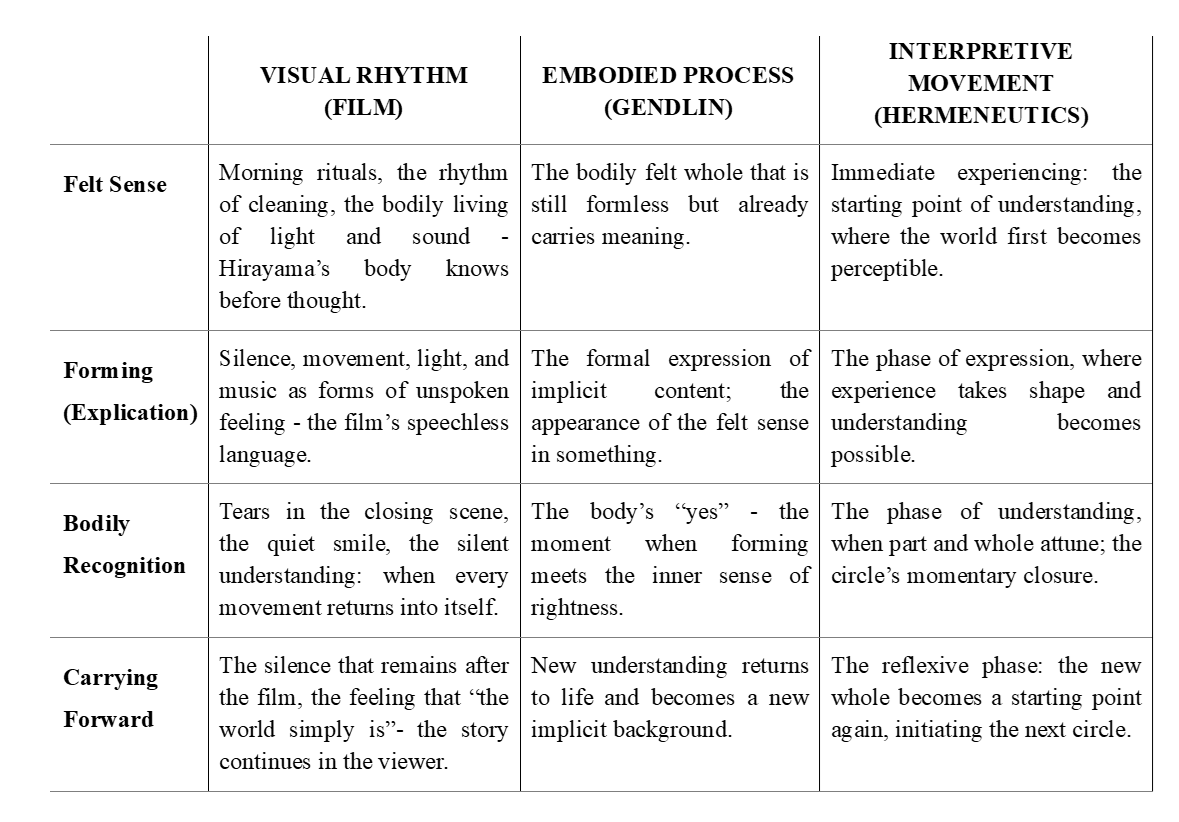
The three viewpoints - the film’s rhythm, the body’s experience, and the hermeneutic circle - are different languages of the same movement. All three show that understanding is not the operation of consciousness, but life’s self-movement. The images of Perfect Days, Gendlin’s experiential concepts, and hermeneutic thinking build on the same inner logic: meaning is not given from outside, but is born from the shared resonance of world and human. Thus the film does not interpret reality; it breathes with it - and the viewer enters this circle not as interpreter, but as participant. Here, understanding is not inference but a relationship being born - a quiet, bodily yes to what is happening.
The Art of Presence
The special quality of Perfect Days lies not in its plot but in its mode of being. This film practices the art of presence: a way of life tuned more to the unspoken than the spoken. Hirayama’s dignity does not come from success or enlightenment, but from bodily honesty - from doing each task with full attention and caring for what is before him. The film’s silences are not voids, but spaces full of life, where connection and the feeling of life are born - as the bodily felt whole slowly takes form, and a small “yes” signals the carrying forward.
Let It Come
Perfect Days is not about happiness, but about attunement. It shows a person who does not seek meaning, but lives in it. Wenders’s fine rhythm, his attention to light and time, and his trust in the viewer’s bodily sensing all carry the same teaching as Focusing: trust in the body (Gendlin, 2009, p. 106).
When, at the end, Hirayama closes his eyes, the film does not end - it breathes. What had been implicit all along - the quiet fullness of life - now finds form in a tear. And as we watch, something sounds within us too: a quiet recognition, a yes arising from the body. For a moment, the world simply is.
Acknowledgement
I would like to thank Prof. Akira Ikemi and Prof. Hideo Tanaka for the thinking that made this essay possible - even if they didn't know they were doing it at the time.
Bibliography
Gendlin, E. T. (2004). The new phenomenology of carrying forward. Continental Philosophy Review, (37(1)), 127–151.
Gendlin E. T. (2009). Fókuszolás. Életproblémák megoldása önerőből (2nd edn). Egde 2000.
Ikemi, A. (2017). The radical impact of experiencing on psychotherapy theory: An examination of two kinds of crossings. Person-Centered & Experiential Psychotherapies, 16(2), 159–172. https://doi.org/10.1080/14779757.2017.1323668
Makkreel, R. (2008). Wilhelm Dilthey. https://plato.stanford.edu/entries/dilthey/
Pilgrim, R. B. (1986). Intervals (‘Ma’) in Space and Time: Foundations for a Religio-Aesthetic Paradigm in Japan. History of Religions, 25(3), 255–277. https://doi.org/10.1086/463043
Purton, C. (2017). Person-Centred Therapy: The Focusing-Oriented Approach. Bloomsbury Publishing.
[1] Ma (間): a Japanese aesthetic-philosophical concept meaning “gap, interval, in-between.” It denotes the living quality of space/time between things - the pause/silence that is not empty but a meaning-bearing “negative space,” giving rhythm, breath, and sense to forms and events. The sense of ma may appear in silences, compositional empty areas, pauses between movements, or shifts of light and shadow. (Pilgrim, 1986)

Krisztina Svéd is a Certified Focusing Professional, Focusing Trainer and Focusing-Oriented Therapist. She integrates Focusing into her work as a mental health counselor and trainer, helping individuals explore their inner resources and develop personal growth. Krisztina is also a PhD researcher at Corvinus University of Budapest in Hungary, specializing in organizational wellbeing.