

By Bernadette Lamboy
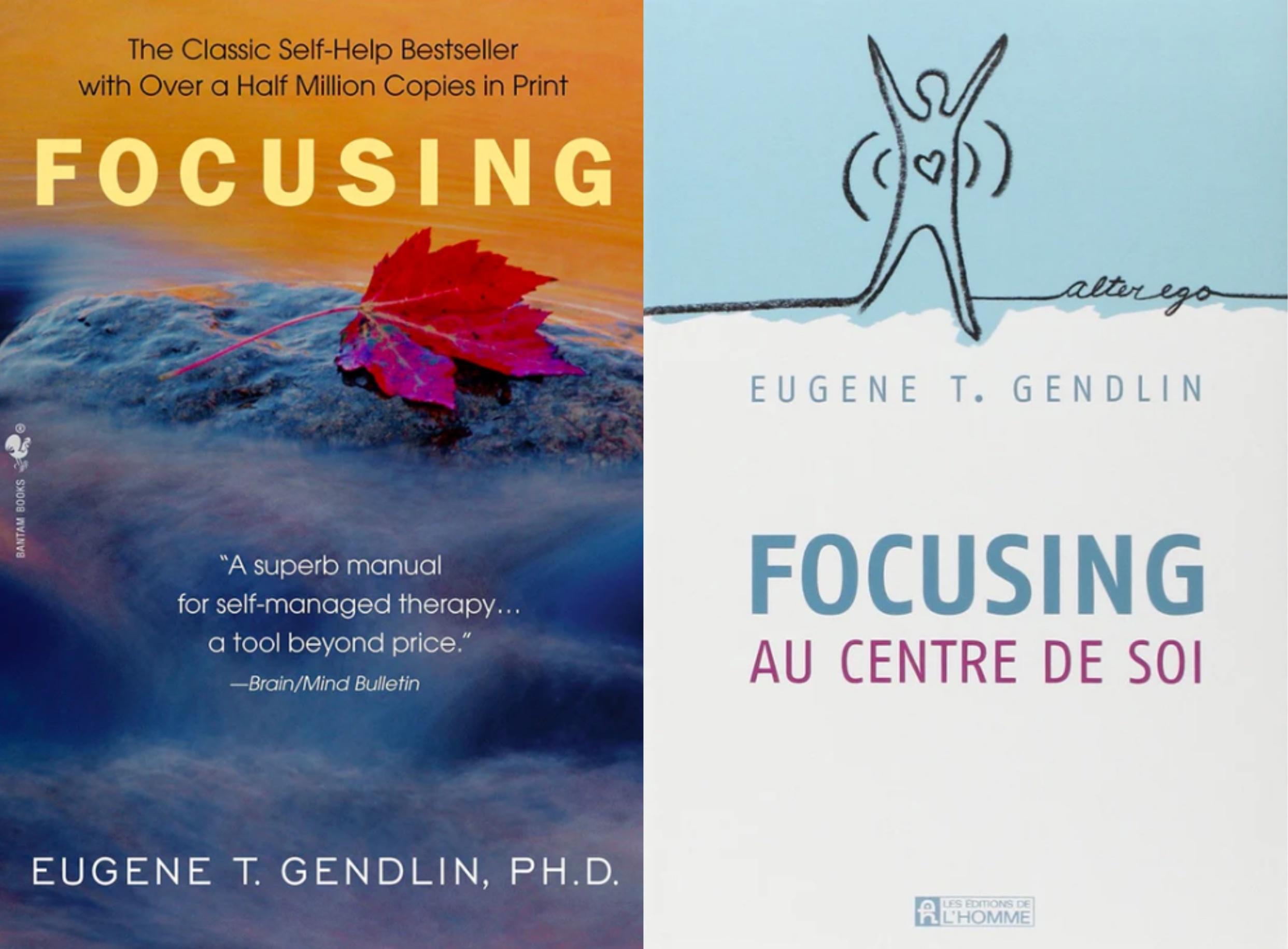
It is with gratitude that I write these few lines. In his book Focusing, « Focusing au centre de soi », Eugene Gendlin taught us a valuable process that has helped many people discover what is right for them, and how to reconnect with themselves. Focusing is at the heart of my professional practice and, quite simply, my life, being as close as possible to myself, and allowing those I accompany to reconcile with themselves and to become the beautiful people they truly are at their core.
This book has had a profound impact on the francophone community, and since its first translation into French in 1984, it has enabled thousands of people to embrace a caring approach that has helped them grow. It is shared in more than a hundred countries and supported by numerous scientific studies, references which can be found on the website of the International Focusing Institute (TIFI). Focusing deserves to be available to everyone, which was Gendlin’s aspiration when he chose to present it in a clear and accessible way.
Even though this foundational book was written several decades ago, it continues to be of great relevance. It makes Focusing available to everyone, allowing one to come as close as possible to what is being experienced within oneself, to find appropriate answers to one’s questions, and to untangle many complex and painful situations. While it is not strictly speaking a therapeutic approach, though it can have therapeutic effects, it is above all an approach to life, as it helps us connect or reconnect with the flow of life within us.
At a time when we are flooded with information to the point that it becomes difficult to distinguish between what is true and what is false, when constant communication coming from all directions has become the norm, and when offerings of every kind are multiplying, it is urgent to come back to ourselves. A pressing need is being felt to take the time to pause, reconnect with ourselves and rediscover our essential values. Making space for what lights us from within and gives flavor and meaning to our existence becomes both a necessity and a deep yearning.
To do so, we need to return to ourselves and take the time to define what truly matters to us. Not allowing ourselves to be overwhelmed by the many suggestions or demands requires that we sort through them, but on what basis? In this regard, Focusing is a valuable ally. It provides us with the inner reference points needed to shape our life choices throughout our lives. It helps us recognize what is truly good for us and teaches us to free ourselves from external pressures and influences. Through Focusing, we cultivate our autonomy and learn to honor what is most important to us.
Let us now turn to the approach itself. Gendlin proposes an original process that takes into account our felt bodily experience. Beyond our biological or physiological body, “encapsulated within our skin,” as Romain would say, it involves coming into contact with a more subtle, sensitive body, one that holds a kind of knowledge capable of teaching and guiding us. Gendlin outlined this process in six steps to help us find our way through our inner labyrinth. These steps are landmarks that Gendlin succeeded in making explicit so that we may move forward with confidence along a path we have too often neglected: trusting our bodily reference points to orient ourselves and make decisions.
This path is innate. It functions naturally in very young children for whom vocabulary is still unfamiliar, but as they gradually develop their thinking, they learn to mull things over and often move away from this innate ability. Some people continue to rely on it but, most of the time, without being consciously aware of it. With Focusing, we reconnect with this natural process with the difference that we can apply it consciously and intentionally. It can then unfold fully and offer us its full potential and richness.
Focusing invites us to turn our attention inward. It relies on an inner attitude free of judgment, open to a particular kind of bodily experience that we have translated into French as sens corporel (felt sense or bodily felt sense) in order to highlight its originality and to distinguish it from emotions or other reactions that are also felt in the body.
The expression sens corporel (bodily felt sense) is especially appropriate because the word “sens” in French is polysemous. The connection with the senses (at play in exteroception, but also interoception and proprioception) is evident: here we are dealing with an inner sense that comes close to what is called cenesthesia, which is the general feel of the body from the inside. There is also the meaningful sense that gives us the clarity we are seeking and allows us to gain a new understanding. Finally, there is the directional sense that points toward a new future. Through the bodily felt sense, Focusing gives us information connected with each of these three meanings of the word “sens.” The felt sensation that is present is perceptible; from it, we draw a meaning that will shed light on things for us and, most often, give us a sense of direction - a direction for our subsequent actions. In this way, all three senses are present.
The bodily felt sense is what gives Focusing its originality, and it should not be confused with everything that may occur within us, for many things happen inside! The bodily felt sense touches a lived and experienced wholeness. It is the sensitive and perceptible result of all our involvements in any given situation. As a result, by listening to it, we can become informed about what a situation truly means for us.
The felt sense informs us and teaches us because it is a precise and reliable indicator of what a situation is making us live. Yet we must take the time to listen to it and to hear its message. When listening to this globally felt sense, we may ask the question: “What are you trying to let me know?”
In my view, this approach is revolutionary and avant-garde.
First of all, through the definition of the felt sense, Gendlin succeeded in bringing to light a dimension of the person that most often goes unnoticed and cannot be assimilated to any other. He stayed with it and came to understand what anyone could draw from it. What at first might have seemed like a vague, barely perceptible impression, something negligible, can actually give useful insights that allow us to better adjust and orient our lives.
The process then reverses our usual priorities. Instead of relying first on thought, analysis, and reflection, which operate within the realm of what is already known, it draws from a new dimension, from what is not yet known. The felt sense offers us access to this new dimension. By turning toward something that is at first vague and unclear (the bodily felt sense), barely noticeable, yet confirmed by a real felt experience that becomes more precise as we give it our attention, we can, quite remarkably, gain access to a new way of seeing things. It reveals what we are seeking to know and responds to our questions, often in unexpected ways. And this surprise is a good sign, revealing a new way of approaching the situation. As people often say, “The situation hasn’t changed, but I no longer see it in the same way.” Even if we had already sensed it vaguely, it is then strongly confirmed. In addition, we are able to recognize the answer as the right one because our body experiences a particular inner movement of release and relief (a felt shift). It is like when you find a misplaced object or the word that was on the tip of your tongue. You may search around for the right word, but when you finally find it, something shifts in your body, perhaps a sigh, that lets you know that this is the one, and not another. The confirmation comes through a new bodily felt sense.
It is true that, very often, we overlook this felt sense; we ignore that impression that lingers in the background like a feeling guiding our steps. It is that something that makes us say, this feels right to me, or on the contrary, this doesn’t feel right. Some call it intuition, and with Focusing, we are given the grammar of intuition: the art of describing a way of accessing it, of intuiting, of finding a path to a direct and self-evident knowing. This intuitive knowledge is embodied because it comes through the body in its most subtle form.
Gendlin helps us understand that this felt sense, this well-known bodily knowing, knows far more than anything we can tell ourselves, analyze, or try to understand about a situation. At first glance, it may seem strange to seek answers in a place that is vague and difficult to grasp. This is the true genius of Gendlin: to have understood that, through this approach, we gain access to unexplored inner territories capable of revealing what we need to know. Moreover, he succeeded in making this process explicit, offering us a way to navigate this inner journey. And he cared deeply about sharing it.
There is in this bodily felt sense something like an inner compass, capable of guiding our steps and letting us know what is good for us. We easily speak of body intelligence or body wisdom. The body is wise in more than one way: it knows how to repair the injuries it undergoes; it knows how to heal and restore itself. With Focusing, we address the body in this sensitive, experiential dimension revealed through the felt sense, so that it may show us what will heal our psychological wounds, restore us in our wholeness, and make us more fully alive.
Our natural state would be to live within the flow of life and grow like a plant. However, the conditions for our growth are not always favorable; we endure many kinds of trauma, both small and large. These psychological wounds too often lead us into a limited, fearful, and diminished way of living. Finding ways to free ourselves from these restrictions is, of course, important both for our personal health and for public health.
The bodily felt sense is a messenger. In its own way, it brings us messages once we learn how to listen to it. As such, it emerges from the totality of what we are living in a given situation because it underlies our thoughts, emotions, conditioning, fears, but also our resources and potentials. It is global in nature. Gendlin says that it exists before the body-mind split, in a more fundamental, more primitive dimension, within an organismic wholeness, referring to the term used by Carl Rogers, with whom Gendlin studied.
In this day and age, people speak readily of a bio-psycho-social-ecological approach, to which we can add cultural and spiritual dimensions, in an effort to restore the person to their wholeness. It appears that with Focusing and the notion of the felt sense, we encounter a sensitive wholeness that gathers together all the implications woven into any situation we explore. By turning our awareness toward this vital and living primordial dimension, by delving into the roots of life at the edge of consciousness, perhaps we connect with a universe in creation, where implicit information can become manifest, revealing itself to us and making itself heard.
The felt sense is, in a way, at the interface between the created and the uncreated, the implicit and the explicit. Through this unique bodily experiencing, we bring together what is local, what manifests in our body, or sometimes just around the energetic body, and the non-local, the information dispersed throughout other dimensions of the universe. Perhaps I am taking you a little far into my passionate reflections but from my experience and long practice, I can say that Focusing is a way of traveling deeply toward the essence of what enlivens us, and of connecting with something beyond what we know.
To unfold the Focusing process is to allow change to manifest itself. When we are suffering, we deeply hope that some kind of change can take place. Yet most of the time, we do not have the instructions for how to make that happen. With Focusing, those instructions become available to us.
The felt sense carries change within itself, but it must first be allowed to express itself. It is with this intention that we turn toward the felt sense and invite it to share the information it holds. This way of proceeding calls for an attitude of not-knowing, a letting go of the mind’s need to control, along with openness, availability, and a curiosity free of pressure, simply motivated by interest. There is always a sense of suspense in this approach because it is a process of emergence. It is impossible to know in advance what will emerge; the only certainty is that whatever comes forward will contribute to improving our situation. Instead of focusing on the mind in an attempt to understand, we de-focus (release the focus) from our thinking in order to listen to the body and place our attention, to focus on what emerges from the felt sense. The word Focusing is not always easy to translate into French, yet we keep it because of its internationality. Nevertheless, it beautifully conveys the process of bringing something initially vague into clearer focus, much like the auto-focus of a camera lens.
Focusing is to engage in a sequence of inner gestures carried out with kindness, that is with an attitude of openness, non-judgment, welcoming, and of recognition toward what life is offering us in the immediacy of our living experience. After creating favorable conditions for ourselves, (settling into a comfortable place, perhaps closing our eyes, making sure we can give ourselves some uninterrupted time, and breathing quietly) we can begin to listen to what is happening within us. From a metacognitive perspective, we can easily identify several inner movements: I define the situation I want to explore, then I turn my attention inward, toward my body, which means stepping away from mental chatter and conceptual thinking. I then place myself in a state of listening and observing, opening to and sensing my inner space; I allow myself to be drawn toward a vague yet tangible bodily sensation — the felt sense — that calls for my attention in connection with the situation I am exploring. Once I notice it, I stay with it and breathe in its presence so that the felt sense can become more perceptible, clearer, and more precise — I bring it into focus. Then I allow the word, image, sound, or gesture to arise – the one that expresses this bodily felt experience. In that moment, I listen to it from a place of not-knowing and I enter into dialogue with the felt sense: “What do you want to show me that I do not yet know? This is where the felt sense begins to reveal its message or messages. I welcome them and feel the benefit and rightness of what has emerged in my body.
The entire process is, in principle, quite simple once we are able to maintain our attention on the felt sense and on what unfolds without interference. Sometimes a whole sequence of images arises from there, unfolding one after another until something finally emerges that comes in response to the situation. Allow what comes to come. Trust the process, which somehow knows, even when we do not consciously know where it is leading us. Such an attitude is unique, almost disorienting, because it invites us to move forward with the felt sense as our only guide. No interpretations, no conceptual frameworks, no intervention from a mind that believes it already knows. Simply welcoming and listening to what emerges. It is a way of opening ourselves to something beyond our beliefs and perceptions. Discovery lies at the heart of the felt sense, much to our relief.
Gendlin wanted to make this process accessible to everyone. He wanted each person to be able to make it their own and to integrate it into their way of living as fully and as well as possible. Focusing can be practiced with the support of a skilled companion, but also alone, through self-Focusing, once the process has been learned.
Guillaume:
I did a self-Focusing session about my fear of making mistakes and my lack of self-confidence. I settle comfortably and turn toward what all this feels like: my inner ground is trembling. I feel it in my chest and belly, like blocks crashing into one another, as if there were many fragmented pieces colliding with each other. I stay for a while with this image arising from the felt sense: the image of ice cubes comes. There is the sense that they are knocking against each other, but already something has changed: on the one hand, they are smaller than the original blocks, but also being in water, their collisions are already somewhat softened.I continue and keep observing them colliding and rolling against one another. I let their impacts come fully alive so I can sense them more deeply. I notice that they are gradually beginning to melt. So I continue. I arrive at something liquid. It is transparent and horizontal. Then it becomes golden and vertical. It is honey. Warm, golden, flowing honey. It is delicious. I can feel it flowing down my throat. I can savor it on my tongue, then swallow it and feel how good and pleasant it is. Honey, simply!
I take time to savor this new sensation.
I return to the original situation to check on the inner change, its stability, and how things are now. I bring to mind a situation in which I had given up out of fear of making a mistake. What I now feel in the face of difficulty, and even failure, is no longer the panic of losing my way and betraying myself. Instead, there is a sense that something interesting is there, something to discover, something calling forth my capacities for intelligence, heart, and creativity.
The ice cubes crashing into one another like dangerous icebergs were discouraging. The warm honey, on the other hand, is something I can savor and share within a relationship.
The issue is no longer a matter of life and death, but rather of a warm exchange in which it becomes quietly possible not to know, to say something foolish, to make mistakes, to correct oneself, to begin again, and to move forward together.
Daring to trust ourselves on perceptible sensations, experienced in our felt sense and bodily felt is an adventure at every moment. This intimate connection with what barely distinguishes itself and gently rises into awareness is an art of living that Eugene Gendlin knew how to share with great simplicity and relevance. Through ongoing practice, not only in difficult situations, but in every moment of our daily life, our sensitivity becomes more refined. In sharing Focusing with us, Gendlin entrusted us with an invaluable gift.
Through his book Focusing, « Focusing au centre de soi », Gendlin opened the door to a life that is more comfortable, more fulfilling, and more creative. By helping us recognize the felt sense, he offered us access to an implicit knowing capable of responding to our deepest aspirations for living well. By teaching us how to unfold the entire Focusing process, he provided us with ways to loosen what constrains and limits us, so that we may move toward what is best for us. He taught us how to let the living flow freely through us and how to be inhabited by the simple joy of being alive.
Translated by Michèle Jodoin, edited by Patricia Manessy
Bernadette Lamboy, Ph.D. in Psychology, was deeply inspired by Carl Rogers’ humanistic approach, which became the foundation of her professional and personal path. For more than 40 years, she has studied Focusing and has taught Focusing with enduring passion through the IFEF (French-Speaking European Focusing Institute). Bernadette is the author of several books, including two dedicated to Focusing: Becoming Who I Am (DDB, Paris, 2003) and Finding the Right Solutions Through Focusing (Le Souffle d’Or, Gap, 2009), the latter of which has also been translated into Spanish.