

Some Ways Practicing Focusing Carries Over Into Life Relationships— “Listening and a different way of being” *
* “Not sure the changes, but yes… Listening and a different way of being.” (A focuser speaking about Focusing and life relationships.)
Anthony Ocone
May 2024
My initial curiosity:
I wondered if the practice of Focusing affects focusers in their relationships. Do the activities, the ways of doing Focusing— things such as slowing down, pausing, then sensing within; cultivating an attitude of open curiosity towards what one finds there; and further, allowing for a bodily felt response and resonance to come in relation to that— affect us in how we are with others in life. What about the structured form of the relationship, being the focuser, one who gets to say what is wanted or needed, or alternatively, being the attentive companion who provides a receptive yet firm presence? Does this affect how we and others are in our relationships? The answer I found is yes: Focusing does affect us in how we relate with others in our daily life.
I spoke with six focusers about their experiences around this wondering. Five of the six had studied Inner Relationship Focusing. One person had not. All of them, regardless of the approach studied, spoke similarly. The prominent and primary place of change within themselves, and also where they noticed outward shifts in their relating to others, was in their experience of listening. In conversations this listening was described as an expanded way of being, illuminated from within by awareness that turns inwards towards oneself, ventures outwards towards others, and includes the space that holds both. The quality of relational experience shifts and can become more fluid. These shifts and ways of being are spoken of as not fixed, not permanent, but rather growing and receding according to how one is doing in the moment. I clearly heard from the focusers that however one is doing, even when relating is challenging, there are positive changes in how they hold the experience. There is some awareness that remains open and flexible. This provides for greater capacity in response, action, or non-action, along with enriched curiosity and appreciation for people and the world. These changes can extend to the other person even if they do not practice Focusing.
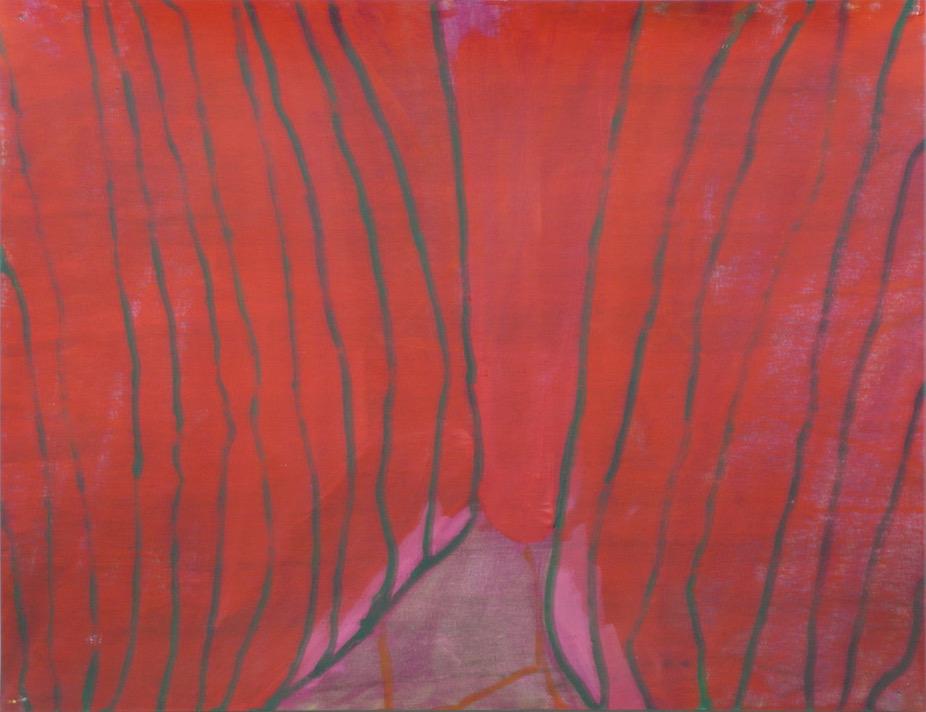
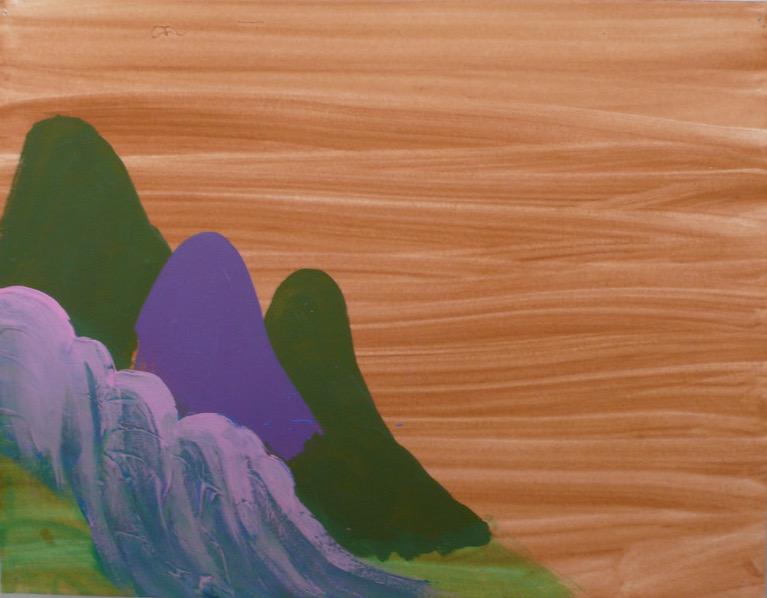
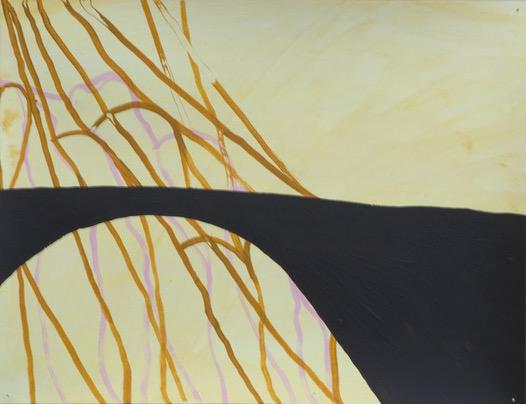
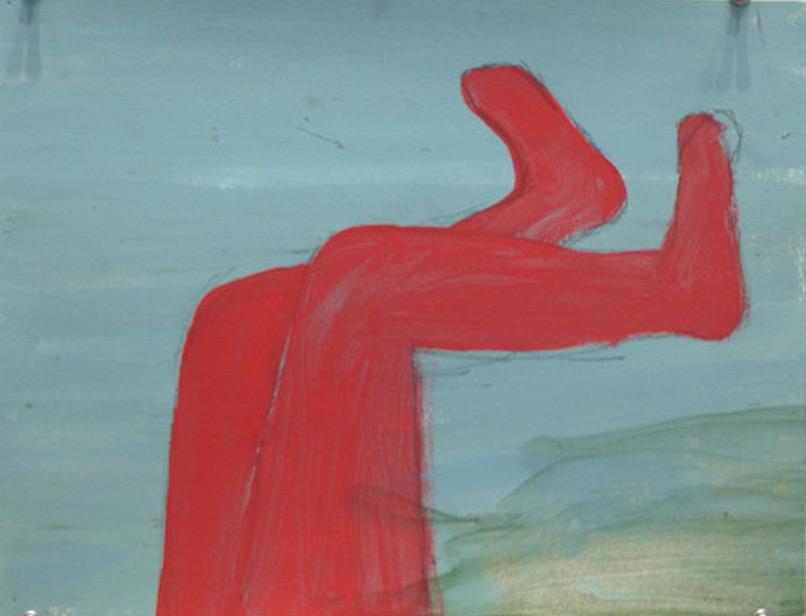
All images above and below were created by Anthony Ocone.
Each piece, (inspired by something special) is a part of his process of letting what comes, come.
The practice of slowing down, of pausing in order to attend to what is present inside which one encounters in Focusing, carries over into life relationships. It is the primary change, and then other good shifts follow. One immediate shift is that in the slowing down there tends to be a softening, a willingness to be with whatever is present. As focuser “N” observes in her own life:
“There’s some kind of a pausing that definitely comes from the focusing space. I'm seeing that as a change in how I am with myself in relationships. It used to be [that] I couldn't tolerate a frustration in a relationship. I acted a lot more on impulse. I’m seeing that I'm able to tolerate more space and more pausing before acting.”
Along with the focuser slowing down within, time feels to slow down outside. The space of relating seems to grow, feeling larger and roomier. A quality of breathability enters the space. Combined with slowing down and pausing is sensing for what is present inside. This awareness and connection to what is going on within bring a sense of being located in oneself, connected to one’s particular experience. The voice that emerges from this place of slowness, pause, and inner connection can be clear and more precisely expressive. As one focuser shared about this inner turning and outward expression:
“…it’s the practice of going in to sense what is going on for me and how things are sitting in my body that helps me to pause, then to kind of percolate or metabolize how I'm going to then bring it up in a relationship. So maybe there's a little bit more of that kind of being empowered to listen in to my needs and wants."
By connecting with oneself first then looking outwards, the softening mentioned above continues. There can be a more open way of seeing, a wondering that is more inclusive of oneself and the other person. This is not to say that it is a frictionless space; relationships still provide an invigorating emotional landscape. The focusers spoke of the challenges of relationship, though they described being more able to navigate those challenges as a result of practicing Focusing. They had a greater sense that they are in relationship, that it is dimensional and interactive, a landscape of connectedness. From those conversations with focusers about relationships, an image arises: a circle with multiple centers. It is you. It is I. It is both of us together. In this circle with multiple centers, the center is mobile, it can move too. As this focuser observes, a lively intelligence enters the dynamic of being with another:
“…it is a reminder to notice that we are an interaction all the time. Sometimes we take people’s words very concretely and misconstrue, I know sometimes I do that…there is something that comes in from Focusing …when I really kind of breathe and remember, it's an ongoing interaction that is greater than the specific word that was said at the specific time. Something larger is holding the relationship, or the interaction is larger than just whatever our words are.”
The practice of Focusing allows one to become intimate with and to hold closely the feelings and sensations inside, and at the same time to dis-identify from those feelings, sensations, and thoughts, clarifying that what we are experiencing as not being “I”. It certainly feels sometimes like the “I” and our experience are the same, but when it does, that too can become clear to us. We can be companions to that feeling.
This experience of dis-identifying enters into relationships as well. Focusers experience it within themselves and extend it to others. This is part of the larger softer space. Trust grows, creating a willingness to open for a moment, maybe a moment of not knowing. Pausing and slowing down allows for any urgency for forward motion to relax a bit, encouraging one to look and see freshly. “J” speaks to these shifts:
“It has changed the way that I listen or expanded the way that I listen. I'm more willing to just let things be, that's part of the practice, just make space for what comes up without trying to make sense of it right away, put it into some sort of theory. It's just noticing without interacting with it right away.… It's kind of a relief to (say): ‘Oh, I don't have to explain this right away or even ever.’”
The space between two people becomes more fertile and something new can arrive there, new action arises out of that. Sometimes the action takes the form of non action. “J” describes how this shows up in her coaching work:
“Altogether it has broadened my idea of what is helpful within other relationships particularly in my coaching work. I was thinking about some of the coaching that I've been doing…. It makes it a little easier to sit back a bit. My tendency is often to try, particularly when someone comes to you and says: ‘I need your help with this.’ So it's helped me broaden my definition of what's helpful a bit.… I often feel the drive to give information and sometimes in a way that the person can’t take it in because they're not in a place to take it in…. It's made me more aware of my side of the interaction in that."
Similarly, in “E’s” experience the light of Focusing awareness allows for greater discernment to what is helpful which points to new possibilities in response:
“Not taking responsibility for the other person's experience— That's a challenge for me in close, familiar family relationships… where someone is suffering, and of course you want to fix it and it's usually not up to you. Focusing has helped me become aware of that.
The instance I'm thinking of is other people's anger, frustration…. Just having a little more breathing room to assess whether it's my job to fix it.”
Other times it is a shift in quality.
“M” has been reflecting on her roles in life, being a daughter, a sister, a partner. Those roles are fixed and haven’t exactly changed, but they are less constricted by ideas of what they should be and instead are places where life happens. There is refreshment within. Speaking about her relationship with her mother, she said:
“They [parents] can read you. They don't care about the words that you say, or how you present your face of: ‘Everything's fine’. They can just feel it. I know my mother could have felt it before. Our relationship… wasn't horrible, but there was this kind of unhappiness…. Now I still help her maintain her house. I take care of everything. Nothing has changed…, but I don't feel dread going there (anymore). And she feels like I accept her. So it’s really nice, even though nothing externally has changed.”
In this familiar relationship, only one of the people is a focuser, yet there still is qualitative shift in relating and both people participate in that change.
Maybe part of that life-giving shift comes from feeling deeply heard, as in this description of that experience in a Focusing session:
“…the feeling of being totally listened to in a different way that is kind of hard to describe, actually – felt more of… a kind of physical relief in the body, like a physical relaxation.”

The capacity to be with oneself and others with a firm, gentle, and awake presence is something that moves. It changes, growing, and diminishing according to one’s state of being in a particular moment. There are times when one is not able to access the gifts described. Yet generally it sounds from my conversations with focusers that an atmosphere of greater trust provides conditions for forward movement, engagement, and connection. And that atmosphere clearly comes from Focusing practice.
One thing all the focusers I spoke with mentioned is that their deeper listening comes with an awareness of moments when they aren’t fully present and listening in a way that satisfies. They are aware of how they could grow and improve as listeners.
This awareness appears as an expression of this finely tuned listening itself, as “M” observes:
“This is a growing capacity and is a lifelong practice. You keep learning and at same time become more aware, you see how much further you can go… to really be there and hear what someone is saying, not just through words, but their whole being…. It's almost like saying: ‘I really love you.’”
Challenges come along with learning new ways of being.
One person spoke about bringing aspects of Focusing into life, friendships in particular can be like riding an edge. There is an interplay between wanting to be present for the person, listening fully, receiving them, and yet interacting with them too, having a point of view and making observations from one’s own particular experience. One doesn’t want to cast a Focusing shroud over the interaction, a neutrality that muffles the friendship connection. That does not feel genuine to her. In describing this confluence of Focusing and friendship, she shares that Focusing does allow her to be with another more deeply in a non-Focusing context:
“…sometimes (there is) almost a belief that I need to be a Focusing companion in my friendships too. I don't think that's really necessarily appropriate or realistic, so it's like a kind of a dance, how to really hold that space where you're not putting your own agenda and your own interpretation on someone else. Yet you're still being authentically yourself in relationship because you're not in a Focusing relationship (with that person).”
Later adding: “People want to be seen and heard no matter the relationship”
“J” mentioned developing a heightened body sensitivity as another challenge that came along with Focusing practice. On the one hand this is something that she needed and appreciates. On the other hand there are moments, depending on her emotional state, when she needs to be aware of her more sensitized responses:
“The focus on body awareness…that’s a bit of a two-edged thing. Early on in my work life, when I was in nursing, I had to be quite detached from my physical experience…. [Now] I feel sometimes a little bit flooded by sensations…. It's quite hard to keep it under control, to stop (from) getting overstimulated.”
Though the uneven texture of life remains, at times it is smooth and flowing, other times coarse and knotted, all of the focusers that I spoke with expressed an appreciation for the practice of Focusing. And all of them felt that it has affected them in their relationships positively. They are able to hold experience differently, with greater awareness and equanimity. From that grows flexibility, depth, and richness in their lives. “C” reflects on her recent experience at a gathering with a woman who did “a lot of things that would turn people off”:
“…it [Focusing] makes me more interested in people…becoming curious about the person rather than turning away from them…. Maybe in the past without Focusing, I would have had the choice of being oppressed by my own feeling that I have to be nice or else to stay the hell away from her. Focusing has opened up the possibility of two things: one is I'm much more aware of what's happening in me being around somebody who does these things that make me uncomfortable… and I know also, how to manage my own feelings about her, how I'm reacting to her.”
Later saying: “Actually I can enjoy her.”
In speaking she uses the word “curious”. This capacity to be curious lightly gathers together the various other threads of experience focusers shared of how Focusing has affected their relationships. Focusing provides a foundation that allows for an inquisitive openness to a larger world that holds more to be discovered. There is a gathering movement towards intimacy— “C” is interested in what is here, both in herself and in the other person. Greater possibilities and choices in response emerge. Ultimately there is appreciation for whatever richness is present, and as she says about her experience of this other person: “I can actually enjoy her”.
For me, curiosity is an outcome, a summation of how Focusing shows up in life relationships and the value it brings. All of the focusers I spoke with shared stories about the positive transformations that practicing Focusing offers, shifting how they meet the world, navigating more easily what comes, particularly in relationships.
I offer a special thanks to Mary Fifield who supported me in this writing project. She generously shared her time with me, providing insights and illuminating reflections, along with sharp editing. Plus our time together brought pleasure and delight.
Anthony Ocone began studying Focusing in 2014 under the guidance of David Rome, and later deepened his training with Ann Weiser Cornell. He continues to pursue certification in Focusing. As an artist, Anthony naturally weaves Focusing into his creative process, drawing on a shared sensibility that informs both his art and his inner work. He currently resides in Ojai, California.