
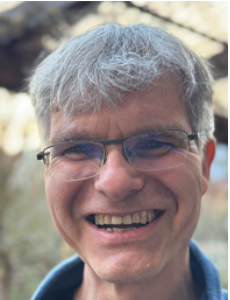
Rachel Hendron recenty spoke with TIFI’s newest board member, Detlef Girke of Germany. In their conversation below, he shares his story - from founding his publishing house to participating in the German Focusing Summer School (often visited by Gene), to discovering TAE and finding his own way to simplify it.
Rachel Hendron: I wondered if I might start by asking you how, as a person, you came to know Focusing.
Detlef Girke: It was in 2003 or 2004. My wife and her son were on a bicycle tour and I sat in our living room and looked at the books on the shelf. And there was the first German issue of Focusing just sitting on the shelf. She had been to a Focusing workshop in the early ‘90s and afterwards she told me about it.
So, I grabbed the book, got back in my seat and read it, and I couldn't stop reading until I was through. And throughout all the reading of the book I felt, “This is my thing, this is absolutely me!” I resonated so much with this book, and I felt so seen by what I was reading. I was Focusing! That was the first moment.
Our relationship was in a crisis at that time, so I was searching for a therapist for myself to handle that situation. After that moment, I began searching for a Focusing therapist. I was living in Hamburg so I got to know Ulrike Röder. She was my therapist and my first Focusing teacher. She offered basic Focusing workshops, but it took a long time because it wasn't very well known. Only a few people joined, and it took about four years just for the first part of Focusing training. But I didn't mind because Focusing was in my life, and I already worked with Focusing for all my difficulties and I was so, so glad with it.
Rachel: What a lovely story. Your wife had learned some Focusing, but you hadn’t.
Detlef: She had. She came home with the book and put it on the bookshelf, then some time went by and then I found it and loved it. Fifteen years, you know, 15 years after she had participated.
Rachel: Fifteen years later! And you found it in the moment when your relationship was in crisis.
Detlef: Yeah, yeah. And then, I joined the German Summer School. In the ‘90s, Gendlin visited the Summer School in Germany four or five times, I think. It’s a big gathering, a get-together, for two weeks with a lot of workshops and a lot of things to learn. And in this Focusing context you don't need to care too much about what you say about yourself. The people who attend will be respectful. Much more respectful than other people in your normal life. And that makes it so precious for me to be there, with so many nice people, and it makes a special atmosphere - that Focusing atmosphere. Sometimes I can get euphoric!
It's so great sometimes and I'm so glad to have something in my life that I can always rely on when there's any problem. I have me, I have my body, and I can really sense what's behind any problem. It's so efficient and it brings me back towards what being a human really means for me. Nervous aliveness and all these things. Wow! Yeah, that's how I started with Focusing.
"The first step is becoming aware of what the problem is. The next step is getting a really deep understanding of the situation you're in, and the last step is giving you a solution."
Rachel: I read that you have a publishing house, you have a way of publishing books about psychology and clinical social work in German, and some tools, but I don’t understand what these tools are. What do you mean? A flow chart, a series of questions or...?
Detlef: Well, we offer smaller and bigger tools but they are all evaluated in a scientific way. This is important for us. Some tools only consist of cards with questions and a special manual. Some are more complicated and you are able to build an expression of your inner landscape on the outside. The most complicated one is being developed at the moment. It consists of cards with questions, metaphoric images, dice, a Persona-Tool, a large board, and so on. It is built in three big groups or dimensions.
The first step is becoming aware of what the problem is. The next step is getting a really deep understanding of the situation you're in, and the last step is giving you a solution. It has a lot of things in common with Focusing and Thinking at the Edge (TAE), but the theory behind it comes from Embodied Design. The idea comes from a professor at the Stuttgart Media University, Judith Papadopoulos.
At the moment, we are building a tool that will be called Flower. It comes from the word ‘flow,’ like ‘Flow-er,’ a conjunction of meanings. It will be released by the end of November, I hope.
We work together, but most things are done by Judith Papadopoulos who wrote a book about it in 2020, and she wanted to do something new. After we talked a bit, she said it would be a good chance to do something new but not a book; something which is more alive, more vivid. That’s how the Flower tool began to develop.
Now she’s made a game in that world. This tool is quite complex but it's very efficient. I have already played it once or twice. The full game takes three to six hours, or it can be shortened to four hours. Afterwards, you have so much clarity about what your next big step is, or you can use this tool to design a larger project based on what the end point has to look like. It's a really great tool to use. She wanted to develop it for design, for creatives, but you can also use it for conflicts or for personal problems. I tested it and it works.
Rachel: You’ve given me a glimpse into this tool and what you do. I am beginning to understand. These tools you make, are they only in German or other languages also?
Detlef: At the moment, only Thetaland is in German and English. We will make a smaller version of Thetaland. I call it Adventuria, and this one we want to translate to English too, but I don't earn any money with this publishing house. I earn money in the accessible IT field; the publishing house just loses money at the moment. I hope that will change soon.
Rachel: And how does this relate to the publishing house?
Detlef: That's an interesting thing. I participated in a TAE workshop with Evelyn Fendler-Lee about 10 years ago, and one of the participants was Tony Hofmann who owned a publishing house at that time. We still meet yearly in Würzburg to have a privately organized TAE workshop on our own. When we were done with one of the workshops in 2019, Tony told me that his laser cutter had broken. It had overheated and didn’t work anymore, but he needed it very urgently for a tool he and I planned to build - a TAE tool called Thetaland which requires a laser cutter to form hexagons out of wood. I had a very successful year in my main job in accessible IT and because of this, I could afford to buy a new laser cutter for Tony. It cost €5,000 at that time and I just gave it to him, and so I told him, “Okay, now you can go on.” And he was so thankful, he said, “Okay, I'll give you my publishing house.” So, in return, I got a publishing house.
We published Thetaland, of course, at ZKS Media - that’s the name of my publishing house - and we have, I think, already five additional tools developed. And we're going on with it and I'm meeting new people.
I never was asking for it, but I'm a curious man and so I started working as a publishing house. Evelyn Fendler-Lee continued to support us and we developed this tool, Thetaland, together. I got to know how to do all these things with books, and then publishing and lecturing, and we began developing more tools.
Rachel: What is on each hexagonal card, a question on it or a word?
Detlef: An introduction to a metaphoric place. A marketplace, a waterfall or a volcano, for example. And you put a pack of 24 cards with questions on each hexagon. Then you choose a place for yourself, draw a card and read the question. All questions are an invitation to look inside, let a Felt Sense come, and then to apply the main rule of Thetaland: give the question a chance. Make it your question by changing it a bit or more. It’s a bit like the question of Gendlin in TAE: "What would you like this word to mean?" And if you get stuck, we have cards with beautiful nature photographs on them. They can help with getting deeper into what is really important at the moment. I liked, from the first minute to the last, to play with it.
Rachel: I haven't got to TAE yet, but I'm taking the classes on A Process Model and Experience and the Creation of Meaning with Rob Parker so I might, one day, know what I would need to know to know what TAE is.
"I wanted to make it easier for people who never used TAE to understand what TAE consists of in some parts."
Detlef: I shortened TAE for myself, you know, and I wrote it down on seven pages or something like that. So very, very easy to read, but I'm afraid only Focusing people can understand. It's not as complex as TAE; I wanted to make it easier for people who never used TAE to understand what TAE consists of in some parts.
You know what my short form of TAE is? Take your problem and bring it somewhere where it's completely free of every association you ever have in yourself. So, confuse yourself, confuse yourself with other things, to bring your problem into a free space. And from that free space, look again at your problem and you will see something different. And you feel the sense of this problem. It will get bigger and bigger, you will sense it more and more, and it brings it much closer to a kind of solution or something that's carrying forward.
Rachel: Oh, outside of its context! Rather than the normal thing of thinking about all the aspects of the problem and...
Detlef: Yeah, yeah. That's the paradox, which Gene meant, or Marion Hendricks. The paradox is a key point in TAE because when you come to a point where you say, no, it's impossible, never, that's the point. That's where it can go on.
Rachel: Well, let me just ask you briefly a little bit about being a newly-appointed member of TIFI's board.
Detlef: They appointed me in in July, and in August I had the first meeting as a board member.
Rachel: Is there anything you particularly hope to achieve as a member of the board? Maybe it’s too soon, I should ask you the same question in 5 years!
Detlef: I have some kind of goal, of course. The first thing is, I really love to meet people from all over the Earth. It's so great to meet so many people all doing Focusing. It's really heart touching - I don't know how to say it, but I love it very much. Another thing is, I want to see how other people bring Focusing into their work, into the world and all those things. What would be the best way to tell people what a great thing Focusing really is?
Rachel: Oh, I love that question.
Detlef: And that's why I joined the board. My reason is just carrying something into the world, bringing some of my values, some peaceful things and Focusing to more people.
And to bring goodwill. I have the board portfolio called "Goodwill." So, when people are attending workshops, I'm saying thank you for helping TIFI be more present in the world and preserving the heritage of Eugene Gendlin.
I’m working together with Catherine on some things relating to Gene's intellectual property. I know some things about property rights, copyright legal ownership, because sometimes in the legal rights to Gendlin's work, this isn't very clear because Gendin didn't care about it. He wanted to have it as a creative commons, but this shouldn't be a reason that every publishing house in the world just publishes his books and earns a lot of money. TIFI should earn money too. And so I'm helping Catherine earn money from it, along with the job of trying to collate the materials and look after them. Gendlin also wanted TIFI to be able to go on and for TIFI to be able to go on, we need money in some way.
Rachel: What an important, practical job. I want to thank you for your efforts to make Gendlin’s work accessible, that seems to be what this is all about.
Detlef: Will you be in Vienna this summer for the International Focusing Conference?
Rachel: Yeah, I will be. Let’s meet then, over Viennese pastries. Goodbye and Auf Wiedersehen till then. It’s been good to get to know you and hear about some of the things you are doing.
Detlef: Bye, till next Summer!
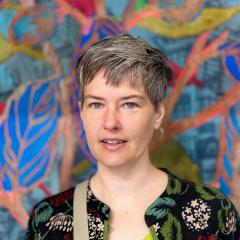
Rachel Hendron is a Certified Focusing Therapist and Trainer, she is an Accredited BACP Psychotherapist and Supervisor and works remotely from England. She is very happily studying Gendlin’s Philosophy of the Implicit, Amerta Movement, making art and working as she travels through her website https://reset.cc/. She is currently leading a series of gatherings online, free for members, called Being Focusing Together.