

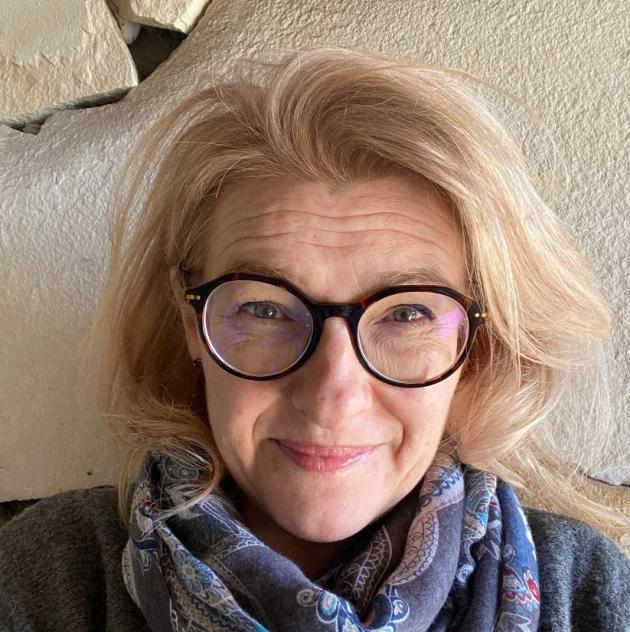
If someone asks me if I am a believer, I would say that yes, I am believer. I believe in Gendlin’s view of living.
I had the pleasure of speaking with Focusing-Orientated therapist, trainer and Coordinator Joanna Kaczmarek about her experience with Focusing, the challenges of introducing Focusing into Poland, and her recent appointment as a member of the International Leadership Council (ILC). Our conversation follows, where Joanna’s warmth and humor shone throughout.
Olivia Hoines: Could you tell us a bit about your background and how you first came across Focusing?
Joanna Kaczmarek: I am a sociologist. I graduated [with a degree in] sociology from the University of Poznan in Poland, and as a sociologist for the first few years I was working in a field of helping people, of some sort. I used to work at the Regional Development Agency and for the National Fund for Environmental Protection and Water Management. I also participated in the American program for developing countries, and studied in the United States for a year and a half.
During my second pregnancy, I decided to do something about my depression and that's how I got involved in therapeutic training. It was the first therapeutic training in my life, and I remember that all of a sudden, I realized it was what I'd love to do. I would like to help people in this way. So, I went to psychotherapy school and I started to study at Intra, the psychotherapy school in Warsaw which taught Integrative Psychotherapy, with a focus on the humanistic person-centered approach. Mostly what I learned from them was this Rogerian approach. Carl Rogers was not yet experiential at that time, but it was "carrying forward."
In 2012 Claude Missiaen, the Belgian Focuser, came to Warsaw and he gave us the first workshop. It wasn't easy for me at the beginning, but I felt is there something for me, something important? Something crucial? I want to learn how to come back to my experiencing, how to come back to listening to what comes from my body in terms of how I am, and what would be the next best step for me. This is how it started. Then, Intra psychotherapy school extended the training program including Focusing workshops for students, and I started to teach. In the meantime, I was certified as a psychotherapist and then as a supervisor.
Introducing Focusing into Poland and building a community
Joanna: Three years ago, I went to the International Focusing Conference in France and I remember a kind of feeling of gee, this Focusing is so wide, it covers so many areas. It's such a rich source for everything! Am I able to introduce it into Poland? I remember it was a kind of decision in me, like should I marry or should I not marry Focusing? I felt that responsibility and I decided to do it.
I have to say that the engine for this undertaking of building a Focusing community, of offering workshops to people in Poland, came from Majka Fijewska who is the co-founder of the Intra Psychotherapy School, together with Claude Missiaen who was of great help here. We started to build structures and to organize. I called the first meeting of the Polish Focusing Institute. I chose people who I knew, who were really excited about Focusing - about eight people altogether. In the meantime, the first Coordinator was announced in Poland - Darek Tkaczyk, who also did a lot to spread Focusing in Poland. After a year and a half, Claude decided finally to make me a second Coordinator in Poland.
During the conference in France, I realized that there is much more to Focusing than Claude was able to show us: There is Whole Body Focusing, Inner Relationship Focusing, Domain Focusing, Thinking at the Edge. It was the first time I had seen so much of it. I thought maybe I'm too old to get to know at least a little bit of each, what should I choose? What's the most important? I made two acquaintances there who I invited to Poland. One acquaintance was Frans Sandbergen from the Netherlands, who came to Poland with a workshop called “The art of getting lost,” based mostly on Thinking at the Edge. The second was Rene Veugelers who did Focusing with children.
Last year, I met Akira Ikemi and invited him to Poland. He’s coming at the end of July with three workshops. So now I'm thinking who next? What I mostly do is look for trainers who are coming to Poland. I organize Focusing-Oriented supervisions with Claude Missiaen each year.
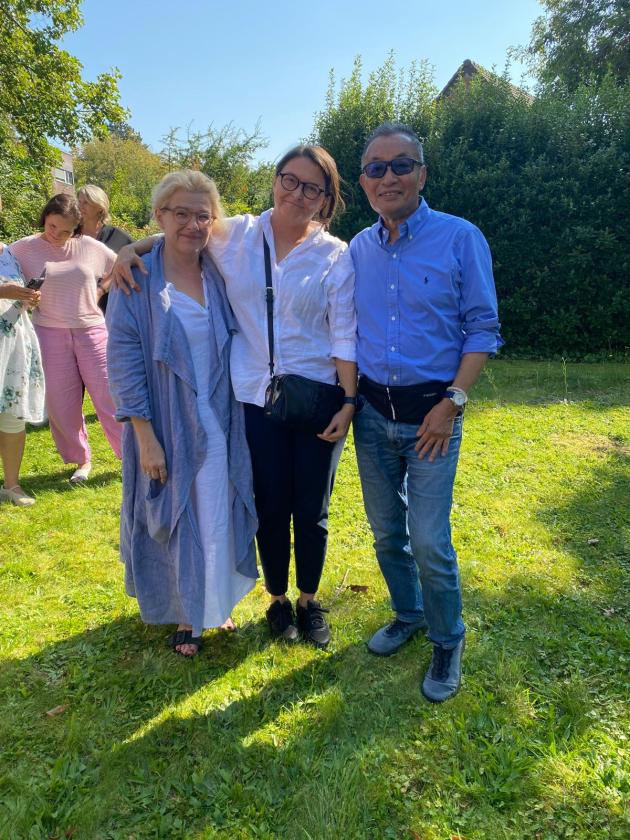
Olivia: It’s such a big undertaking to decide to introduce Focusing into Poland, I’m curious about how that was and what challenges you might have encountered.
Joanna: I remember at the beginning I tried to gather a community, so I started a Facebook group for the Polish Focusing Institute. We have a thousand members now. What we do there is share some translated excerpts from articles about Focusing and announce trainings and events. Now we are translating some articles from Senses of Focusing, the two-volume book released two years ago by Judy Moore (ed).
We are trying to translate articles because one of the biggest challenges is that Polish people often do not speak English. Everything about Focusing that we want to introduce must be translated into Polish. That's the problem. There are only two books translated into Polish that cover Focusing. One is Martin Siems’ book, which includes several chapters on Focusing published in 1992. The other is The Power of Focusing by Ann Weiser Cornell, translated by Agnieszka Klimek and published in 2015.
Agnieszka popularized this book and was the first who introduced to Poland the approach of Focusing with parts, known as Inner Relation Focusing.
Another challenge, at least for us, is attracting trainers to Focusing. Intra has already trained many people in the basics of Focusing but all of them are psychotherapists. Now we have over 20 Focusing-Oriented therapists in Poland and a few trainers. Recently, I started to attract other approaches than the Rogerians, such as Gestalt therapists and psychoanalysts.
This year for the first time I went to a conference for supervisors, with Focusing-Oriented supervision. I was a little bit afraid because they were mostly psychodynamic or psychoanalytical therapists, so for them I expected it would be something really new and fresh, and for some it was. Next year I will take part with a lecture at the Emotion Focused Therapy (EFT) conference where I am going to talk about Focusing too, and I will be introducing Focusing to students at the Catholic University of Lublin.
My colleagues are doing the same, especially Irek Kaczmarczyk and, we are trying our best to make Focusing as familiar as possible. There are now some other people who are engaged in promoting and teaching Focusing in Poland. For example, one is the “Zaufaj ciału” center in Warsaw, which is run by two FOTs, and also in several other regions of Poland. This community is growing and is getting more diverse. There are Inner Relationship Focusers here and they mostly train the trainers. There are also people who received their training at the Institute of Chile and people who are developing spiritual Focusing or Focusing in religious communities, which are quite strong. Those who were taught by Claude work mainly in a process-oriented way, so to speak. I do care a lot about Focusing in Poland growing in a diverse and inclusive way, allowing each person to learn it in their own way and at their own pace.
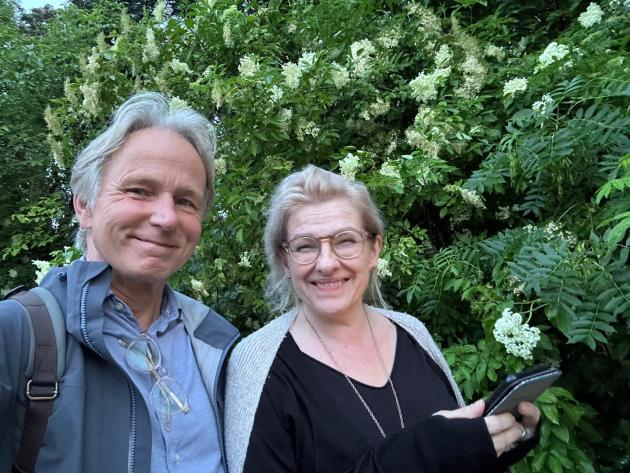
May 2024
Olivia: You are working a lot with therapists, are you noticing any difficulties for therapists trying to integrate Focusing into their therapeutic practice?
Joanna: I mostly teach students of psychotherapy, and I have this impression that almost always, the majority of students love Focusing at first. They do have some difficulties because this requires people to let go of their habitual way of helping. It requires them to trust something. They have to trust the process and themselves to be able to facilitate the person’s own process. It is not that easy. It takes time and practice to find a way to introduce it into their practice.
In the case of other approaches, I need to offer them experience. That's the first thing I can do. Recently, I had a nice conversation about Focusing with a Gestalt colleague and at some point in our talk, he said “so far I don't see the difference between Focusing and Gestalt therapy in terms of phenomenology and philosophy.” We see a lot of similarities, but I need to help them to feel the difference, and I believe the difference is in the felt sense. You don't have to do much. All you have to do is to create a space; a friendly space to facilitate the process. In Focusing-Oriented Therapy, of course we do some other things too. But this quality of being with the felt sense and trusting that it will unfold in certain circumstances and taking care of offering the circumstances, is very often what is enough. Maybe this Focusing attitude is something that I don't feel that all approaches value, this attitude towards personal experience that Focusing offers.
Olivia: What is it that you really mean when you speak about the Focusing attitude?
Joanna: Loving attitude, patient attitude, trusting attitude. This is the phenomenology. Don't assume anything, don't expect anything. Be open to everything that comes. Welcome it regardless of your liking or disliking. Welcome and accept its existence. But the first thing that comes to me is a loving attitude. Much the same as the Rogerian triad: unconditional regard, empathy and authenticity, but more enriched by this phenomenological attitude of patience, openness to the other person’s experience without making assumptions about where their process should go or having to make any effort to understand, and just being curious about whatever comes.
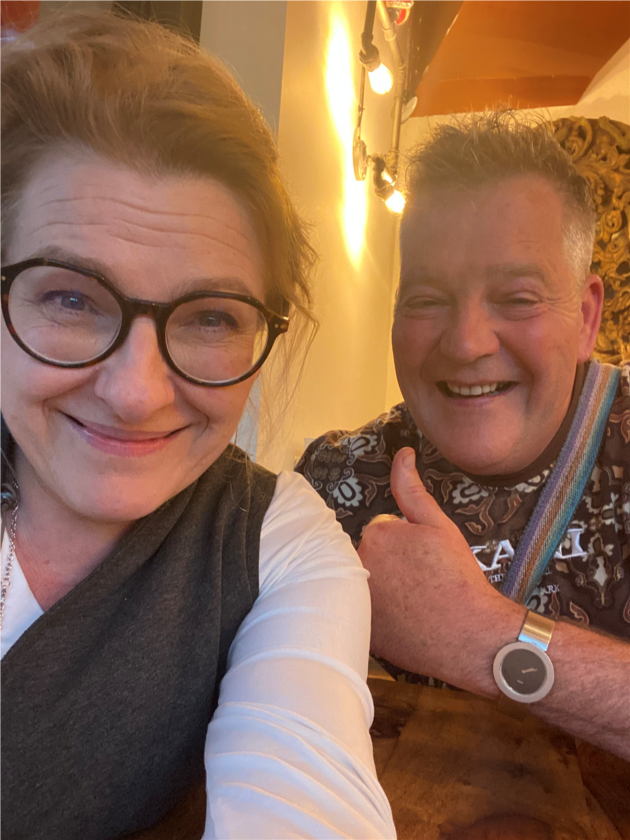
May 2023
Olivia: You said that it's been easier to bring Focusing to therapists rather than people who don't have that kind of training. I'm curious about what your experience has been there.
Joanna: This is because Claude came to psychotherapy school and started to teach psychotherapists. And then when Intra extended and added Focusing to their regular training program for psychotherapists, more and more psychotherapists learned Focusing.
Those Focusers who spread Focusing among their spiritual groups reach out to people from many professions: teachers, nurses, doctors, sellers, everyone. It's easy for psychotherapists now because there are so many of them. Most of the trainings offered in Poland are directed to therapists. Maybe that's also a problem, but I feel I cannot do everything. Thank God there are many other Focusers now, and also trainers.
Olivia: You sound like you're doing a lot. And on top of that, you've just joined the International Leadership Council (ILC) two months ago. What drew you to that role?
Joanna: Claude Missiaen was finishing his last year of working for the ILC and he recommended me. He was my teacher and mentor. He was my supervisor for many years, so he knows me. He felt that I would be good for the international community. He recommended me, and that was maybe the second time when I was thinking, should I marry or should I not marry? I am engaged in so many things here now. But he told me that this is mostly being sensitive to what the Focusing community Coordinators need from the organization. And it doesn't take much time; it’s 2 hours per month and gatherings twice a year. So I decided to join and was verified.
What was interesting specifically for me, as one of the people who introduced Focusing in Poland, was how other countries and other communities from other cultures deal with the mission of Focusing. What are the problems? How can we help? I'm not long there so I cannot say more. I feel that the members of the ILC are competent, caring. friendly, involved, engaged, and excited about doing what they do, so that's such a wonderful group to be in, for sure.
Olivia: I know it's early days, but do you have a sense of what you'd like to see TIFI do, how you would like to see it progress?
Joanna: I'm not sure I know fully what TIFI does right now. Of course, when I go through the website I see many things, and sometimes I think how can these few people do all of this. But I don't have an opinion on what should be the direction of the Institute yet. I have my own reflections but probably on the organizational level rather than the flesh of operations. I don't feel I can answer this question now. I just entered; I just opened the door, so I don't know yet what I’ll see there. If you ask me about my feelings, I would say that things are going the way they should go.
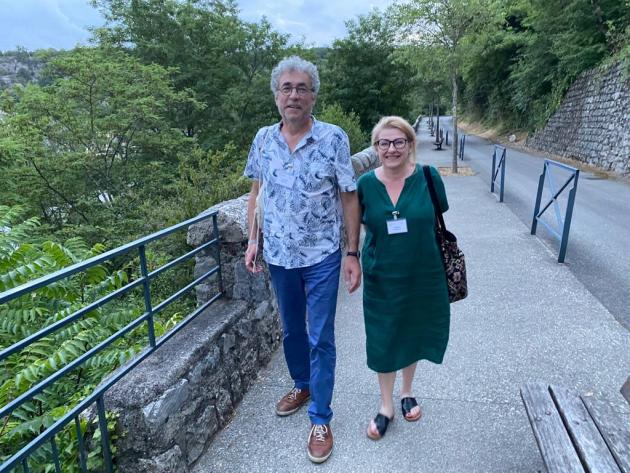
Ardeche, France, 2022
Olivia: You've had so much involvement in Focusing, your own practice and bringing it to so many other people. What’s the most important thing that you feel your experience with Focusing has given you?
Joanna: That's a good question because I have never regarded myself as a missioner, but I feel I am now. I don’t know how I came to this point really, frankly speaking. I feel what Focusing gave me personally was that somehow, Focusing saved my life - enabling me to slow down, to be more present, to be able to choose, to be able to be open to whatever life brings to me. I’m not afraid of many things I used to be afraid of. I came to trust myself; to trust what comes up when I stop and pause. I don't need to protect myself in the world or in life as I used to. More and more, I trust myself and I trust that whenever I stop, I will find out what's going on and what's best for me now. Sometimes I don't have time to stop, but I also learned to not ignore something that is calling. Even if I have a busy day, I find a moment to check what should be taken care of now or at least noticed.
Focusing is something good. Something, that I want people to use for their good. It is quite an easy way compared to all other ways, I believe, because it’s a natural way of being close to yourself, close to your friends, your relatives, to nature and the people you love. Close to all the bigger context, so it's a way of being in life. Almost everyone, or at least everyone who wants to, can learn it. I think this is like giving people water. It's not mine. It's everybody's, but some people are not able to get it on their own. So, someone needs to bring them water. This is what Focusing brought to me, to trust that I don't know now what will happen but something will, and I am open to whatever it is. This is about trust, I believe, but also understanding life processes. I know that life wants to continue. And life does whatever is possible to continue. Sometimes I even say that if someone asks me if I am a believer, I would say that yes, I am a believer. I believe in Gendlin’s view of living.
Olivia: Is there any advice you would give to someone new to Focusing?
Joanna: Don't give up. If you want to learn, you will learn it. It might be difficult at the beginning, but you will see the progress. So don't give up. Rather, look for people who may help you and accompany you in this process.
Olivia Hoines is a Focusing Practitioner, Humanistic-Integrative Counsellor and Teacher. She has a private practice in Bristol, England and has a particular interest in the development of self-compassion and play.